NRIs routinely mix up NRE, NRO, and FCNR accounts — and getting it wrong isn't just inconvenient, it can mean losing tax-free status on interest you earned, or running into repatriation limits you didn't expect. The difference comes down to one question: where did the money come from? Here's exactly which account holds what, and why it matters.
Quick Summary
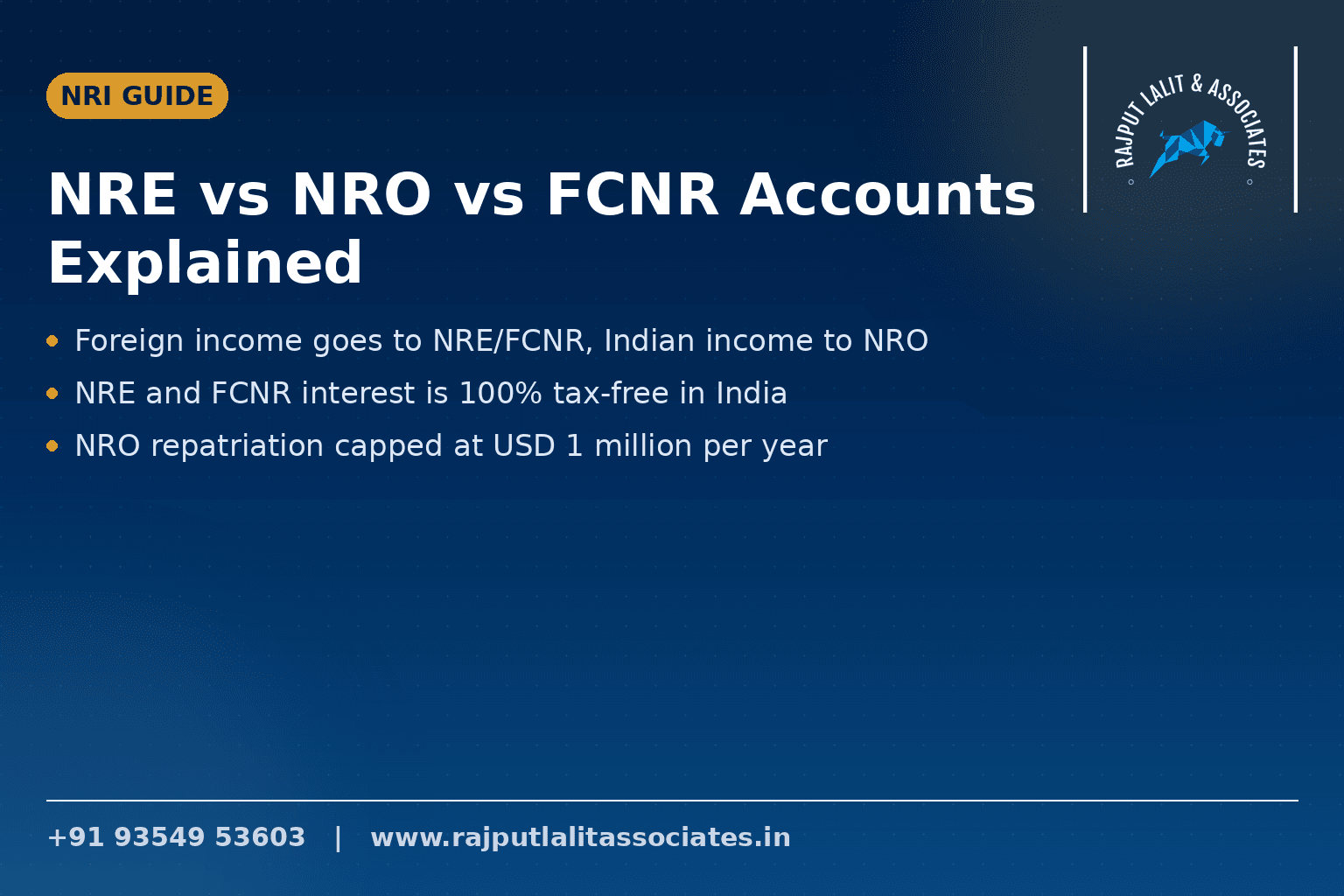
- NRE: foreign income only, INR, tax-free interest, fully repatriable
- NRO: Indian-sourced income, INR, interest taxable + TDS, repatriation capped at $1M/year
- FCNR: foreign income, held in foreign currency, tax-free interest, fully repatriable, no exchange rate risk
- Rule of thumb: money earned abroad → NRE/FCNR; money earned in India → NRO
The Three Accounts, Side by Side
| Feature | NRE | NRO | FCNR |
|---|---|---|---|
| Source of funds | Foreign income only | Indian-sourced income | Foreign income only |
| Currency held in | Indian Rupees | Indian Rupees | Foreign currency (USD, GBP, EUR, JPY, CAD, AUD) |
| Account type | Savings/current/FD | Savings/current/FD | Fixed deposit only |
| Interest tax in India | Tax-free (Sec 10(4)(ii)) | Taxable, 30%+surcharge+cess TDS | Tax-free (Sec 10(15)(iv)(fa)) |
| Repatriation | Fully unrestricted | Capped at USD 1M/year (Form 15CA/15CB) | Fully unrestricted |
| Exchange rate risk | Yes (INR-denominated) | Yes (INR-denominated) | No (stays in original currency) |
The One Question That Decides Which Account You Need
Ask: "Did this money originate outside India, or inside India?" Salary from a foreign employer, business income earned abroad, or foreign investment proceeds → NRE or FCNR. Rent from an Indian property, dividends from Indian shares, a pension paid in India, or proceeds from selling Indian property → NRO. Mixing these up isn't just a paperwork issue — depositing Indian-sourced income into an NRE account can jeopardise its tax-free status and create compliance problems when the source is questioned.
Repatriation — Where the Real Difference Shows Up
NRE and FCNR balances (both principal and interest) can be moved back abroad without restriction, through standard banking procedures. NRO is more constrained: repatriating NRO funds is capped at USD 1 million per financial year, and requires filing Form 15CA (a self-declaration) along with a CA-certified Form 15CB confirming applicable taxes have been paid on the funds. Current income like rent or pension can generally move more freely, but accumulated balances and capital receipts fall under this yearly cap.
NRI Banking, Tax & ITR Filing Support
Rajput Lalit & Associates helps NRIs choose the right account structure, handle TDS on NRO interest, and file accurate returns. Book a free consultation or see our NRI Tax Tools for residential status and TDS calculators.
Frequently Asked Questions
I'm an NRI with rental income and a fixed deposit in India — which account do I need?
Your Indian rental income must go into an NRO account, since NRO is specifically for income earned within India (rent, dividends, pension, capital gains). Your existing resident savings account, once you become an NRI, also needs to be converted to (or replaced by) an NRO account — you can't continue operating a regular resident savings account after your status changes.
Is interest on my NRE account really completely tax-free?
Yes — interest earned on an NRE account is 100% exempt from Indian income tax under Section 10(4)(ii), with no TDS deducted. This applies only while you genuinely hold NRI status; if you return to India and your residential status changes, this exemption stops applying going forward.
How much money can I repatriate (send back abroad) from each account type?
NRE and FCNR accounts allow fully unrestricted repatriation of both principal and interest, anytime. NRO is more limited: repatriation of NRO balances is capped at USD 1 million per financial year, and requires Form 15CA (self-declaration) plus a CA-certified Form 15CB confirming taxes have been paid — current income like rent or pension is freely transferable, but capital/accumulated balances hit this cap.
What's the advantage of FCNR over NRE if both give tax-free interest?
The key difference is currency risk. NRE and NRO accounts hold funds in Indian Rupees, so your foreign-currency deposits get converted to INR at the prevailing exchange rate — if the rupee depreciates against your currency, you gain, but if it appreciates, you lose value in your original currency terms. FCNR deposits stay in the original foreign currency (USD, GBP, EUR, JPY, CAD, AUD) throughout the tenure, completely eliminating this exchange rate risk — useful if you want certainty in your home currency rather than betting on rupee movement.
Can I open a joint account with a resident Indian family member?
For NRE and FCNR accounts, a resident Indian can only be added as a joint holder on a 'former or survivor' basis (meaning the NRI must be the primary/first holder) — the resident cannot operate the account independently during the NRI's lifetime. NRO accounts have more flexibility for joint holding with residents, since the funds are Indian-sourced. Always confirm the exact joint-holding rules with your bank, as implementation can vary.
What happens to these accounts if I move back to India permanently?
Once your residential status changes to resident, NRE and FCNR accounts typically need to be converted to resident accounts (or RFC — Resident Foreign Currency — accounts if you want to retain foreign currency holdings), and the special tax exemptions on interest stop applying from that point. NRO accounts generally continue, since they were already handling India-sourced income. It's worth planning this conversion with your bank around your actual return date rather than leaving it to be sorted out later.
Disclaimer: This article is for general information based on FEMA regulations, RBI guidelines, and Income Tax Act provisions as applicable for FY 2026-27, current as of September 2026. Bank-specific joint-holding rules and procedures can vary — please verify the current position with your bank or consult a professional before relying on it.