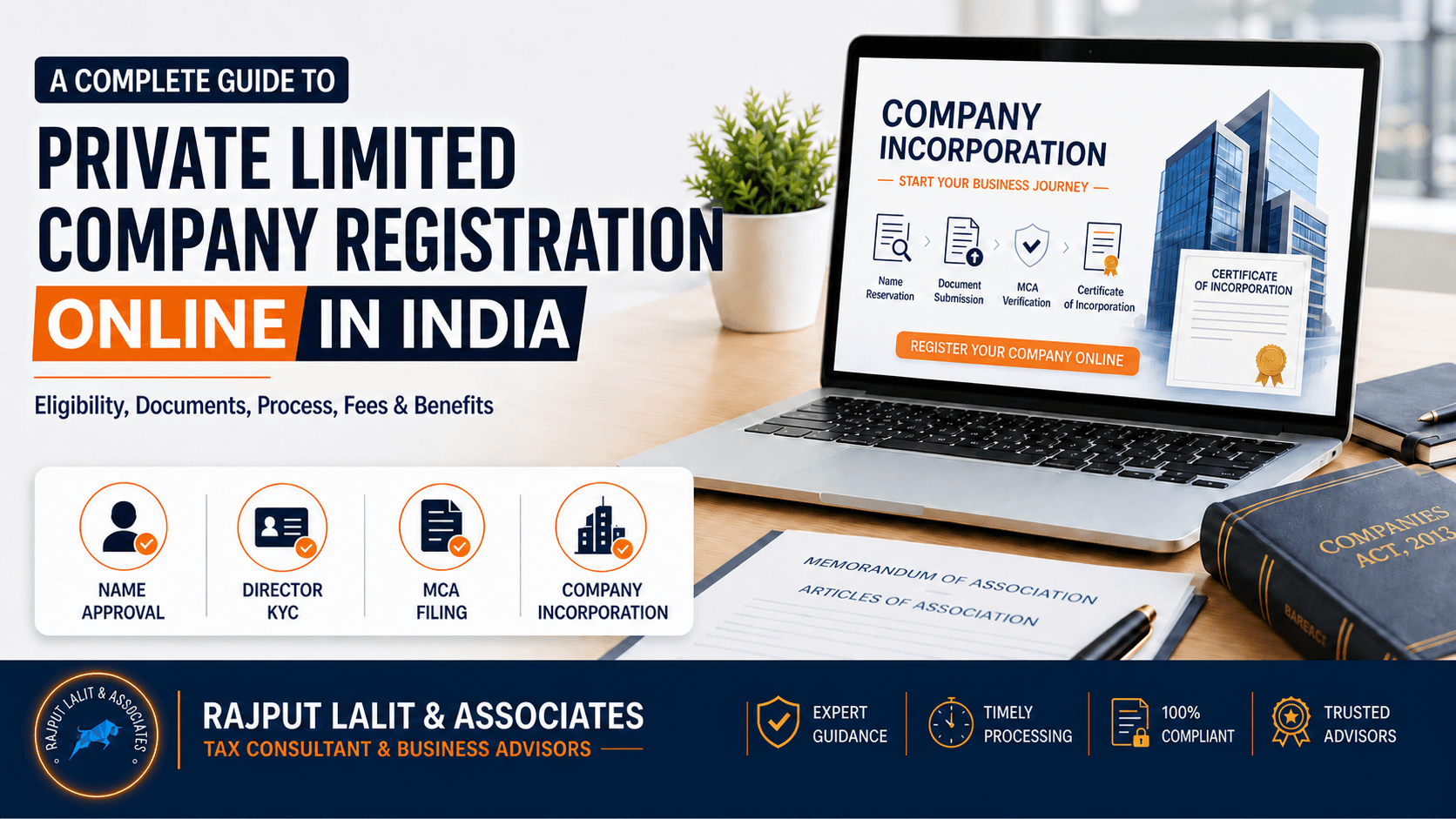
Private Limited Company Registration in India
A Private Limited Company is one of the most common business structures for startups, growing businesses and entrepreneurs in India. It creates a separate legal identity for the business and can help build credibility with customers, investors, banks and vendors.
This guide covers eligibility, documents, the registration process with actual costs and timelines, post-incorporation compliance — including the Form INC-20A deadline that catches a lot of new founders off guard — and common questions.
Quick Summary
- Minimum requirement: 2 directors, 2 shareholders, no minimum capital
- Government cost (₹1L authorized capital): roughly ₹3,000–₹6,000, mostly stamp duty which varies by state
- Timeline: 10–20 working days typically, 7 days in the best case
- Don't forget: Form INC-20A within 180 days, or face a ₹50,000+ penalty
What is a Private Limited Company?
A Private Limited Company is a company registered under the Companies Act, 2013. It is treated as a separate legal entity from its owners. This means the company can own assets, enter contracts, open a bank account, raise invoices and carry out business activities in its own name.
The liability of shareholders is generally limited to their investment, subject to applicable law and personal guarantees where relevant. This structure is widely used by founders who want an organised and scalable business setup.
Key Features of a Private Limited Company
Separate Legal Entity
The company has its own legal identity, separate from its shareholders and directors.
Limited Liability
Shareholders' liability is generally limited to their unpaid share capital, subject to applicable legal provisions.
Better Business Credibility
A registered company can build confidence with banks, clients, suppliers, investors and government departments.
Scalable Structure
It is often suitable for businesses planning growth, investment, partnerships or expansion.
Eligibility for Private Limited Company Registration
A Private Limited Company requires at least two directors and two shareholders — the same person can hold both roles. At least one director must satisfy the Indian residency requirement: staying in India for a total of at least 120 days during the previous financial year.
- Minimum two directors, maximum 15.
- Minimum two shareholders, maximum 200.
- At least one resident director (120-day India-stay test).
- A proposed company name that meets MCA naming requirements.
- A registered office address in India.
- A lawful proposed business activity.
- No minimum authorized or paid-up capital required — see below.
Myth: "You need at least ₹1 lakh capital to register a company"
Not since the Companies Amendment Act, 2015. There is no minimum paid-up or authorized capital requirement anymore. Most founders still choose ₹1 lakh as a round, low-cost starting figure — since MCA filing is fee-free up to ₹15 lakh authorized capital anyway and a higher figure only pushes up stamp duty — but nothing in law requires it.
Documents Required for Company Registration
The documents required can differ depending on whether the directors, shareholders or registered office are located in India or outside India. The following documents are commonly required for Indian residents.
| Document | Purpose |
|---|---|
| PAN Card of Directors and Shareholders | Identity and tax-related verification. |
| Aadhaar Card | Identity and address verification, where applicable. |
| Passport Size Photograph | Director and subscriber documentation. |
| Address Proof of Directors | Commonly includes bank statement, utility bill or other accepted proof, as applicable. |
| Registered Office Address Proof | Proof of the company's proposed registered office (utility bill, usually not older than 2 months). |
| NOC or Rent Agreement, if applicable | Required where the registered office is rented or owned by someone else — including a residential address used as the registered office. |
What Does It Actually Cost?
For a typical small company registering with ₹1 lakh authorized capital, here's where the government costs actually come from:
| Cost Head | Approximate Amount |
|---|---|
| MCA name reservation (2 name options) | ₹1,000 |
| SPICe+ incorporation filing fee | Nil — free up to ₹15 lakh authorized capital |
| Digital Signature Certificate (per director) | ₹1,500 – ₹2,500 |
| Stamp duty (₹1L authorized capital) | ₹500 (Delhi/Maharashtra) to ₹5,000+ (Gujarat/Kerala) — state-dependent |
| Form INC-20A (commencement of business) | ₹200, filed after incorporation |
Stamp duty is genuinely the biggest variable — it depends entirely on the state where your registered office is located and your authorized capital amount, so two companies incorporating on the same day with the same capital can pay very different totals. This table doesn't include professional fees for documentation, drafting and filing support, which are separate.
Private Limited Company Registration Process & Timeline
Realistically, this takes 10–20 working days end to end — faster with Aadhaar-based e-KYC and clean documents, slower if the name gets rejected or the Registrar raises a query:
| Stage | Typical Duration |
|---|---|
| Digital Signature Certificates for all directors | 1–2 days |
| Company name reservation | 3–4 days |
| Drafting MoA/AoA and filing SPICe+ | 3–5 days |
| RoC review and Certificate of Incorporation | 5–10 days |
- Discuss the proposed business activity, directors, shareholders and capital structure.
- Collect and verify KYC documents, registered office proof and company details.
- Apply for Digital Signature Certificates for all directors and subscribers.
- Select and apply for the proposed company name through the MCA incorporation process.
- Prepare incorporation documents, including the Memorandum of Association and Articles of Association.
- Submit the incorporation application and linked forms through the MCA portal.
- Respond to any resubmission or clarification request, if raised.
- Receive the Certificate of Incorporation after approval.
SPICe+ and Linked Incorporation Forms
The MCA uses the SPICe+ incorporation process for a new company. It covers company name reservation, incorporation and other related registrations or allotments as applicable.
Supporting forms may include SPICe+ MOA, SPICe+ AOA and AGILE-PRO-S. Depending on the application, PAN, TAN, bank account-related services, GST registration and other linked registrations may be considered through the prescribed process.
Name Approval Matters
The proposed name should not be identical or too similar to an existing company, LLP, registered trademark or reserved name. A relevant business-object description and proper supporting documents help reduce the risk of resubmission.
Benefits of Registering a Private Limited Company
Professional Image
A registered company can improve trust among customers, vendors and business partners.
Funding Readiness
The structure is commonly preferred by investors, accelerators and startups planning to raise funds.
Business Continuity
The company continues to exist independently of changes in its shareholders or directors, subject to law.
Easier Expansion
A structured company setup can support hiring, contracts, banking, tenders and business growth.
Post-Incorporation Compliance — Don't Miss Form INC-20A
Incorporation is the beginning of the company's compliance journey, and the very first deadline is the one most new founders don't know about:
Form INC-20A — Commencement of Business
You cannot legally start business operations or exercise borrowing powers until you file Form INC-20A, declaring that all subscribers have paid for their shares. It is due within 180 days of incorporation, with a government fee of ₹200. Miss it, and the penalty is steep: ₹50,000 on the company, plus ₹1,000 per day on every officer in default (capped at ₹1 lakh per officer). If the Registrar concludes the company is inactive, it can even initiate striking the company off the register under Section 248 of the Companies Act.
Beyond that, ongoing compliance depends on turnover, business activity and employee strength:
- Opening and maintaining the company bank account (typically 1–2 weeks post-incorporation).
- Issue of shares and related statutory records.
- Income tax return and financial statement filing.
- Annual MCA filings (AOC-4, MGT-7/7A).
- GST registration and GST return filing, where applicable.
- TDS, payroll, EPFO or ESIC compliance, where applicable.
- Maintaining books of accounts and statutory registers.
Common Mistakes to Avoid
- Selecting a name without checking availability or trademark conflicts.
- Using unclear or expired address and identity documents.
- Choosing an incorrect business activity or object clause.
- Forgetting Form INC-20A within the 180-day window.
- Not maintaining proper accounting records from the beginning.
- Assuming incorporation alone completes all business compliance.
Frequently Asked Questions
How many directors and shareholders are needed for a Private Limited Company?
A minimum of two directors and two shareholders — the same person can hold both roles. At least one director must be a resident of India, meaning they stayed in India for a total of at least 120 days during the previous financial year (this residency test was relaxed from 182 days some years ago). Maximum shareholders are capped at 200.
Is there a minimum capital requirement to register a Private Limited Company?
No. The Companies Amendment Act, 2015 removed the earlier minimum paid-up capital requirement of ₹1 lakh. You can incorporate with a nominal authorized capital — many founders start with ₹1 lakh purely to keep stamp duty and MCA fees low, not because it's legally required.
How much does it cost to register a Private Limited Company in India?
For a typical small company with ₹1 lakh authorized capital, government costs alone run roughly ₹3,000–₹6,000: ₹1,000 for name reservation, nil MCA filing fee (SPICe+ is fee-free up to ₹15 lakh authorized capital), ₹1,500–₹2,500 per director for Digital Signature Certificates, and stamp duty that varies sharply by state — from around ₹500 in Delhi/Maharashtra to over ₹5,000 in Gujarat or Kerala. Professional fees for documentation and filing support are separate.
How long does company registration take?
Realistically 10–20 working days end-to-end: 1–2 days for Digital Signature Certificates, 3–4 days for name approval, several days to draft the MoA/AoA and file SPICe+, and the remainder for the Registrar of Companies to review and issue the Certificate of Incorporation. With Aadhaar-based signatory verification and error-free documents, it can move closer to 7 days — but name rejections or document queries commonly stretch it past 20 days.
What is Form INC-20A and why does it matter right after incorporation?
INC-20A is the declaration of commencement of business — you cannot start business operations or exercise borrowing powers until it's filed, and it's due within 180 days of incorporation. Missing it isn't a minor lapse: the penalty is ₹50,000 on the company plus ₹1,000 per day on every officer in default (capped at ₹1 lakh per officer), and the Registrar can eventually strike the company off the register under Section 248 if it appears inactive.
Is GST registration compulsory after company incorporation?
No, not automatically. GST registration depends on turnover crossing the applicable threshold, the nature of the business, and whether you're making inter-state supplies. A newly incorporated company with no turnover yet is not required to register for GST from day one.
Can a company use a residential address as its registered office?
Yes, a residential address can be used as the registered office, provided you have valid address proof (a utility bill or similar, usually not older than 2 months) and, if the property isn't owned by a director or subscriber, a No Objection Certificate from the owner.
Why Choose Rajput Lalit & Associates?
Rajput Lalit & Associates provides professional support for business registration, GST, income tax, accounting and compliance services. We help founders organise documents, understand the incorporation process and prepare for post-registration compliance — including tracking your INC-20A deadline so it doesn't slip past you. See our Company Registration service or our MSME (Udyam) Registration service if you're registering as a proprietorship or partnership instead.
Structured Documentation Support
Guidance for director KYC, registered-office documents and company information.
Clear Compliance Guidance
Practical next-step support for GST, tax, accounting and related obligations — including INC-20A tracking.
Transparent Process
Clear communication on the documents and information required for your application.
Pan India Support
Online assistance for eligible founders and businesses across India.
Planning to Register a Private Limited Company?
Book a discussion to understand the documents, process and compliance requirements for your proposed business.
Book a ConsultationDisclaimer
This article is for general informational purposes only and is not legal, tax or professional advice, based on the Companies Act, 2013 and MCA rules as of September 2026. Government fees, stamp duty rates and compliance requirements can change and vary by state. Please seek professional advice based on your proposed company structure and business activity.
Poori tasveer ek jagah: sahi business structure chunne se lekar registration aur saalana compliance tak sab kuch humari Business Registration Complete Guide India 2026 mein padhein.