GST 2.0 was the biggest rate-structure overhaul since GST launched in 2017. Instead of four working slabs (5%, 12%, 18%, 28%) plus cess, the Council collapsed everything into a simpler four-tier system — and moved a large number of everyday items down a slab. If your invoicing, billing software, or price lists still reflect the old rates, this is worth checking immediately.
Quick Summary
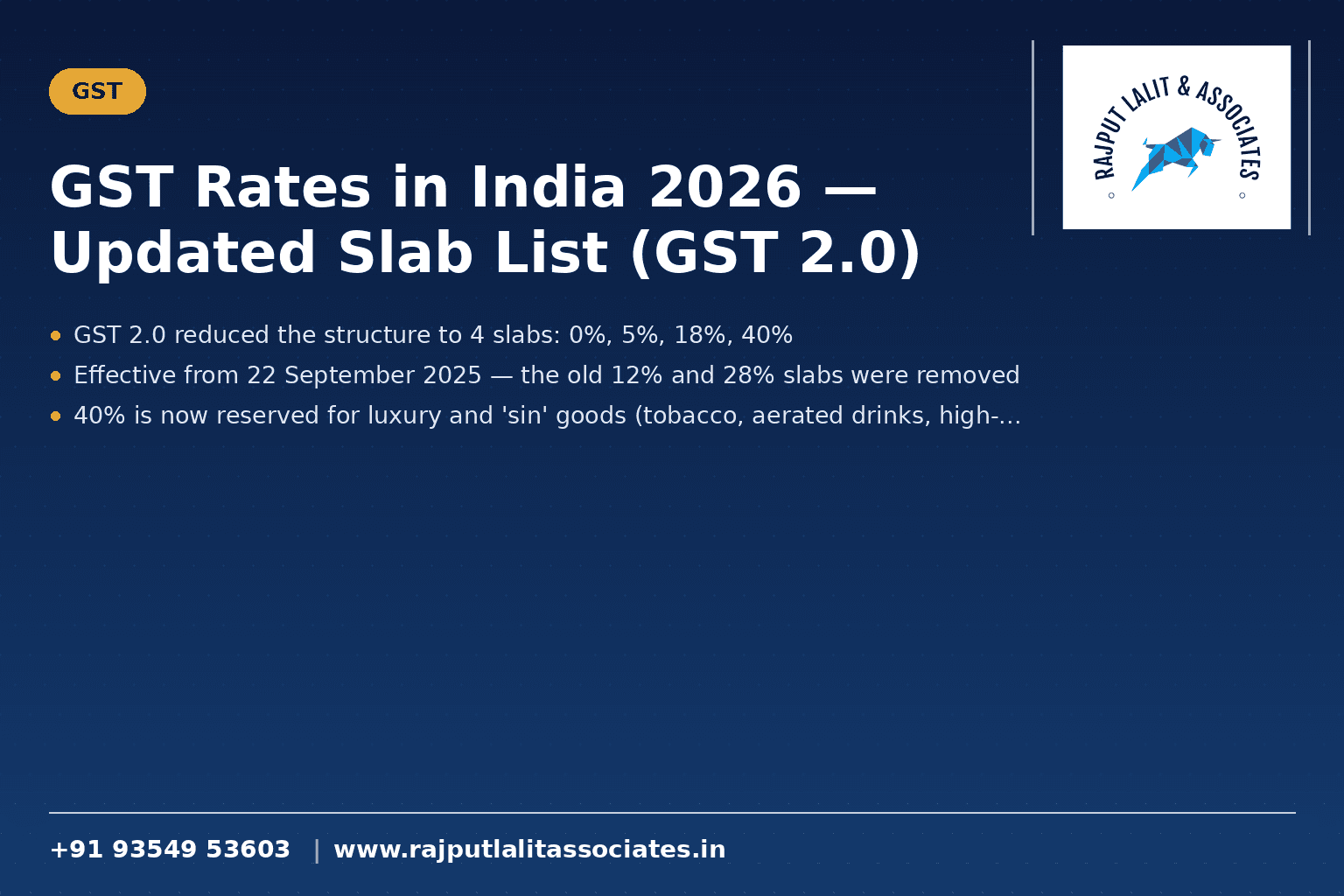
- GST 2.0 reduced the structure to 4 slabs: 0%, 5%, 18%, 40%
- Effective from 22 September 2025 — the old 12% and 28% slabs were removed
- 40% is now reserved for luxury and 'sin' goods (tobacco, aerated drinks, high-end vehicles)
The Four Slabs (Effective 22 September 2025)
| Slab | Typical Items |
|---|---|
| 0% (Nil-rated) | Maps, charts, globes, pencils, exercise books, notebooks, and other specified essentials |
| 5% | Hair oil, toothpaste, soap, milk, butter, ghee, utensils, packaged snacks, sanitary napkins |
| 18% (Standard) | Automobiles (most categories), electronic appliances, ACs, TVs above 32", apparel priced above ₹2,500 |
| 40% (Luxury/Sin) | Aerated and carbonated beverages, tobacco products, pan masala, motorcycles above 350cc, personal-use aircraft |
What Actually Changed
The earlier 12% and 28% slabs have been eliminated — items that sat in those brackets were reclassified, mostly moving down to 5% or 18%, with only genuinely luxury/sin categories pushed up to the new 40% slab. The stated intent was to simplify classification disputes (a large share of GST litigation historically involved arguing whether something belonged in 12% vs 18%, or 18% vs 28%) and to make everyday goods cheaper.
What Small Businesses Need to Check Right Now
- Update your billing/invoicing software's rate master — an invoice raised at an old, incorrect rate is a compliance problem, not just a pricing one
- Re-check your HSN/SAC code to rate mapping — reclassification can mean the same HSN code now attracts a different rate
- Review pending contracts/quotations that assumed the old rate structure
- If you deal in goods that moved from 28% to 18%, check whether accumulated ITC needs any adjustment
A Word of Caution
Rates Get Revised — Verify Before You Price/Invoice
GST rate notifications are amended periodically, and specific product classifications are sometimes clarified or corrected after the initial rollout. Before finalising pricing on a new product line or a large invoice, it's worth a quick verification against the current CBIC notification rather than relying on last year's rate card.
Getting your rate master wrong isn't a small mistake — it flows into every GSTR-1 and GSTR-3B you file afterward. Rajput Lalit & Associates helps businesses re-map their rate structure after GST 2.0 and handles ongoing GST Return Filing. Book a free consultation if you're unsure whether your current rates are correct.
Frequently Asked Questions
When did the new GST 2.0 rate slabs take effect?
22 September 2025. Any invoice raised on or after this date should reflect the new 0%/5%/18%/40% structure.
Are the 12% and 28% slabs completely gone?
Yes, as standard working slabs — items that were taxed at 12% or 28% have been reassigned into the 5%, 18% or 40% brackets depending on the category. A small number of special rates (like on gold/precious metals) may continue to sit outside this four-slab structure.
Why is there a 40% slab now instead of 28% + cess?
The 40% slab consolidates what used to be a 28% GST rate plus a separate compensation cess on luxury/sin goods into one straightforward number, mainly applying to tobacco, aerated drinks, and select luxury vehicles.
My product's rate seems to have changed — how do I confirm the correct current rate?
Cross-check your HSN/SAC code against the latest CBIC rate notification, or have your GST consultant verify it — classification disputes are common enough that a quick professional check before large billing runs is worth the time.
Does this affect GST registration thresholds?
No — the ₹40 lakh/₹20 lakh (goods/services) registration thresholds are unrelated to the rate slabs and have not changed because of GST 2.0.
GST rate slabs are set by CBIC notification and can be amended. This article reflects the GST 2.0 structure as understood as of September 2026 — please verify the current rate for your specific HSN/SAC code on the GST portal or with a professional before invoicing.