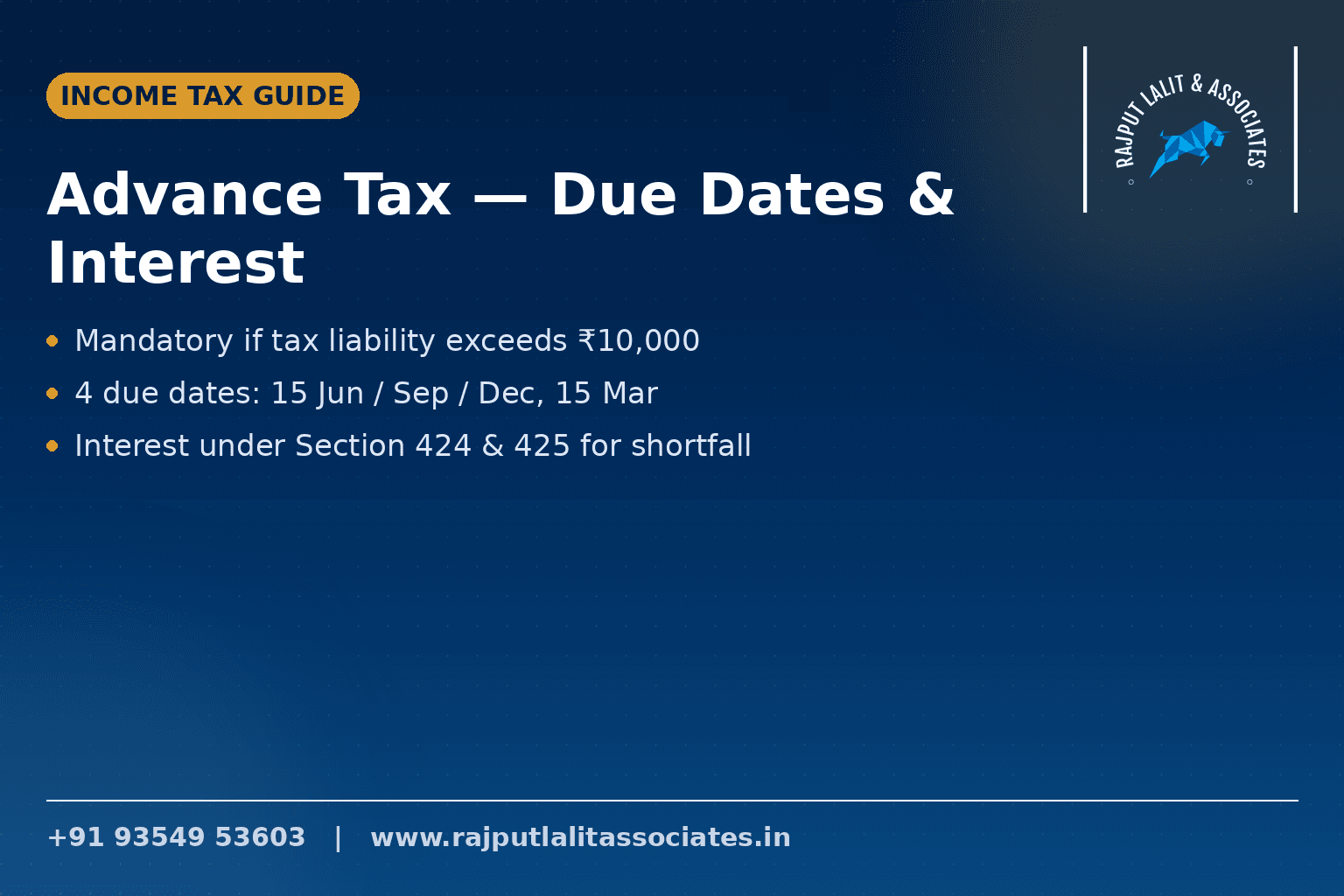
If your tax liability for the year — after whatever gets deducted as TDS — crosses ₹10,000, the law expects you to pay tax in instalments through the year, not in one lump sum when you file your return. Miss an instalment and it isn't just late; it's interest that starts accumulating quietly and adds up by the time you file. Here's who's covered, the exact dates, and how the interest actually gets calculated.
Quick Summary
- Who pays: anyone with tax liability above ₹10,000 after TDS — salaried, freelancers, businesses (senior citizens without business income are exempt)
- Due dates FY 2026-27: 15% by 15 June, 45% by 15 Sept, 75% by 15 Dec, 100% by 15 March (cumulative)
- 44AD/44ADA presumptive taxpayers: single instalment, 100% by 15 March
- Interest for overall shortfall: Section 424 (old 234B) — 1% per month if less than 90% paid by 31 March
- Interest per missed instalment: Section 425 (old 234C) — 1% per month on each instalment's shortfall, independently
Who Must Pay Advance Tax
The ₹10,000 threshold is on your net tax liability — total tax due for the year, minus TDS/TCS already deducted on your income. This regularly catches people who assume advance tax is only for businesses: a salaried person with rental income, significant capital gains, or freelance/consulting income on the side can easily cross ₹10,000 in net liability even with salary TDS already being deducted. Senior citizens (60 years or above) are exempt from advance tax — but only if they have no income from business or profession that year.
Due Dates and Cumulative Percentages — FY 2026-27
| Instalment | Due Date | Cumulative % of Tax Due |
|---|---|---|
| 1st | 15 June 2026 | 15% |
| 2nd | 15 September 2026 | 45% |
| 3rd | 15 December 2026 | 75% |
| 4th | 15 March 2027 | 100% |
Note these are cumulative figures — by 15 September you should have paid 45% of the full year's estimated tax in total (not an additional 45% on top of June's 15%).
Freelancers & Small Businesses — the Single-Instalment Option
If you've opted for presumptive taxation under Section 44AD (business) or 44ADA (professionals — doctors, consultants, freelancers, designers etc.), you're not required to follow the quarterly schedule. You can pay your entire year's advance tax in one instalment by 15 March, which simplifies things considerably if your income is hard to predict quarter by quarter. This relief doesn't apply to Section 44AE (goods transport operators), who follow the regular quarterly schedule.
Interest for Default — Two Separate Provisions
| Provision | Applies When | Rate |
|---|---|---|
| Section 424 (old 234B) | Less than 90% of total tax paid as advance tax by 31 March | 1% per month, from 1 April until paid |
| Section 425 (old 234C) | Any individual instalment falls short of its cumulative % | 1% per month on that instalment's shortfall (3 months for June/Sept/Dec shortfalls, 1 month for March) |
These stack independently — you can owe Section 425 interest for missing the June instalment even if you're fully paid up by year-end, and separately owe Section 424 interest if your year-end total still falls short of 90%. The one relief: tax on capital gains or other genuinely unpredictable income (lottery winnings, for instance) is excused from Section 425 interest for the instalment in which it arose, provided you pay it with the very next instalment.
Advance Tax Planning & Filing Support
Rajput Lalit & Associates helps individuals and businesses estimate advance tax accurately each quarter and avoid interest under Sections 424/425. Book a free consultation or see our Income Tax Return Filing service.
Frequently Asked Questions
Who is required to pay advance tax?
Anyone whose estimated tax liability for the year, after subtracting TDS/TCS already deducted, exceeds ₹10,000. This covers salaried employees with significant other income (capital gains, rent, interest), freelancers, professionals, and business owners — not just businesses. Senior citizens (60+) are exempt only if they have no income from business or profession; a senior citizen running a business still has to pay.
What are the advance tax due dates for FY 2026-27?
15% of the year's total tax by 15 June 2026, 45% (cumulative) by 15 September 2026, 75% (cumulative) by 15 December 2026, and 100% by 15 March 2027. Each instalment is measured against the cumulative percentage of your full-year estimated liability, not a fresh 15%/30%/30%/25% split.
Do freelancers and small businesses under presumptive taxation follow the same 4 installments?
No — if you've opted for presumptive taxation under Section 44AD (business) or 44ADA (profession), you can pay 100% of your advance tax in a single instalment by 15 March, instead of the quarterly schedule. This relief does not extend to Section 44AE (goods transport).
What's the difference between interest under Section 424 and Section 425 (old 234B and 234C)?
Section 424 (old 234B) applies if you've paid less than 90% of your total tax liability as advance tax by 31 March — interest runs at 1% per month from 1 April until you pay the balance. Section 425 (old 234C) is separate and applies per quarter — even if your total advance tax by year-end is fine, paying too little by a specific instalment date triggers interest for that instalment alone, calculated independently.
I underpaid my June instalment but caught up by September — do I still owe interest?
Yes, for that instalment specifically. Section 425/234C interest is charged per instalment based on what was due by that date, regardless of what you pay later. A shortfall in the June or September instalment generally attracts 3 months' interest on the shortfall amount; a shortfall in December also attracts 3 months; a shortfall in the final March instalment attracts 1 month. Catching up later reduces your Section 424 exposure but doesn't erase the earlier instalment's Section 425 interest.
Is there any relief if my income is genuinely hard to estimate in advance (like capital gains)?
Yes, for one specific case: capital gains and certain other income that arises unexpectedly (winnings, dividend income you couldn't have anticipated) is exempt from Section 425/234C interest for the instalment in which it arose, as long as the tax due on it is paid in the immediately following instalment. Regular business or salary income doesn't get this relief — it has to be estimated and paid on schedule.
Disclaimer: This article is for general information based on the Income-tax Act, 2025 (Sections 424 and 425, corresponding to the old Sections 234B and 234C) as applicable to income earned from 1 April 2026 onward, current as of September 2026. Please verify the latest position or consult a professional for your specific situation before relying on it.